 Login with Google
Exit Readiness – Your key to exiting your Recruitment Business
Business owners typically choose between trade sales, private equity, and Employee Ownership Trusts (EOTs) based on their desired exit speed, valuation expectations, and long-term commitment to the business. While a trade sale involves selling to another recruitment business, private equity focuses on the company as a financial asset, and an EOT transitions ownership to the employees with specific tax advantages.
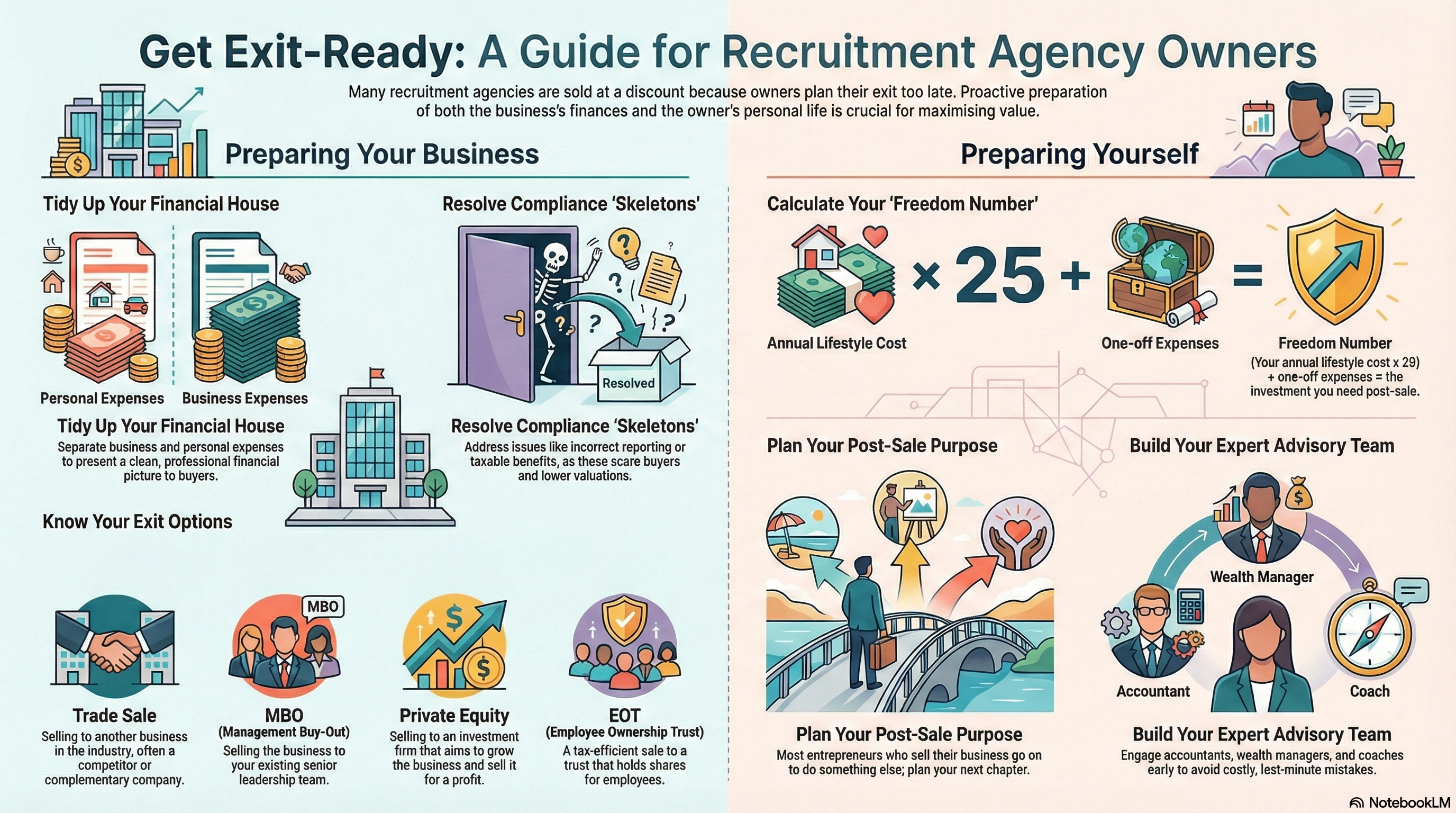
Comparison of Exit Strategies
|
Feature
|
Trade Sale
|
Private Equity (PE)
|
Employee Ownership Trust (EOT)
|
|---|---|---|---|
|
Buyer Type
|
Another recruitment company.
|
Financial investment firm.
|
A trust held for employees.
|
|
Typical Goal
|
Strategic growth or geographic expansion.
|
Maximising ROI/asset value (“pound of flesh”).
|
Preserving legacy and employee benefit.
|
|
Seller Commitment
|
Usually a 2-year transition or earnout.
|
Can be a quick exit, especially for distressed sales.
|
Long-term: 6 to 7 years to achieve earnout.
|
|
Tax Benefit
|
Standard capital gains tax applies.
|
Standard capital gains tax applies.
|
No capital gains tax for the seller.
|
|
Cultural Impact
|
Moderate; depends on integration.
|
High; can be “harsh” on culture, leading to staff turnover.
|
High; employees gain a “piece of the pie”.
|
——————————————————————————–
Trade Sales
A trade sale occurs when you sell your business to another recruitment firm, often one looking to enter a different geographical market or add a new specialism. For example, a company focused on manufacturing might acquire an industrial recruitment business to expand its desk offerings. Sellers should expect to remain involved for roughly two years during a transition period.
Private Equity (PE)
Private equity firms generally view a recruitment business as an asset rather than a culture-driven entity. This can be the “harshest” option regarding business culture, as staff may leave if they do not align with the new financial focus. PE is often a viable route for distressed sales, where a buyer might acquire a business at a discounted price due to internal errors or the need for a quick turnaround.
Employee Ownership Trust (EOT)
The EOT is a growing trend that allows a seller to achieve a good valuation without paying capital gains tax. However, this is not a “walk away” strategy; the seller must typically remain committed and involved for six to seven years to back the financial figures required for their earnout. If you are looking for a quick exit, an EOT is likely the wrong choice.
Key Considerations for Exit Readiness
Regardless of the chosen path, being “exit-ready” requires significant preparation:
• Financial Tidiness: Sellers must remove personal expenses—such as family members on the payroll or personal cars—from the business accounts to present a clear “lifestyle-free” valuation.
• The “Freedom Number”: Christian Ma suggests calculating what you need to maintain your lifestyle, multiplying it by 25, and adding one-off expenses (like paying off a mortgage) to find your target investment figure.
• Due Diligence: Buyers will look for “skeletons in the closet,” such as improper employment intermediaries reporting, lack of settlement agreements for staff entertaining, or missing P1Ds for taxable benefits.
• Business Plan: Having a documented business plan is vital as it tells the story of your decisions and demonstrates to a buyer that your success was not just “by luck”.
Are you currently evaluating which of these routes best fits your personal timeline, or are you in the early stages of preparing your accounts for a future sale?