Google Is No Longer the First Place Your Clients Search. Is Your Recruitment Agency Ready?
By Nitin
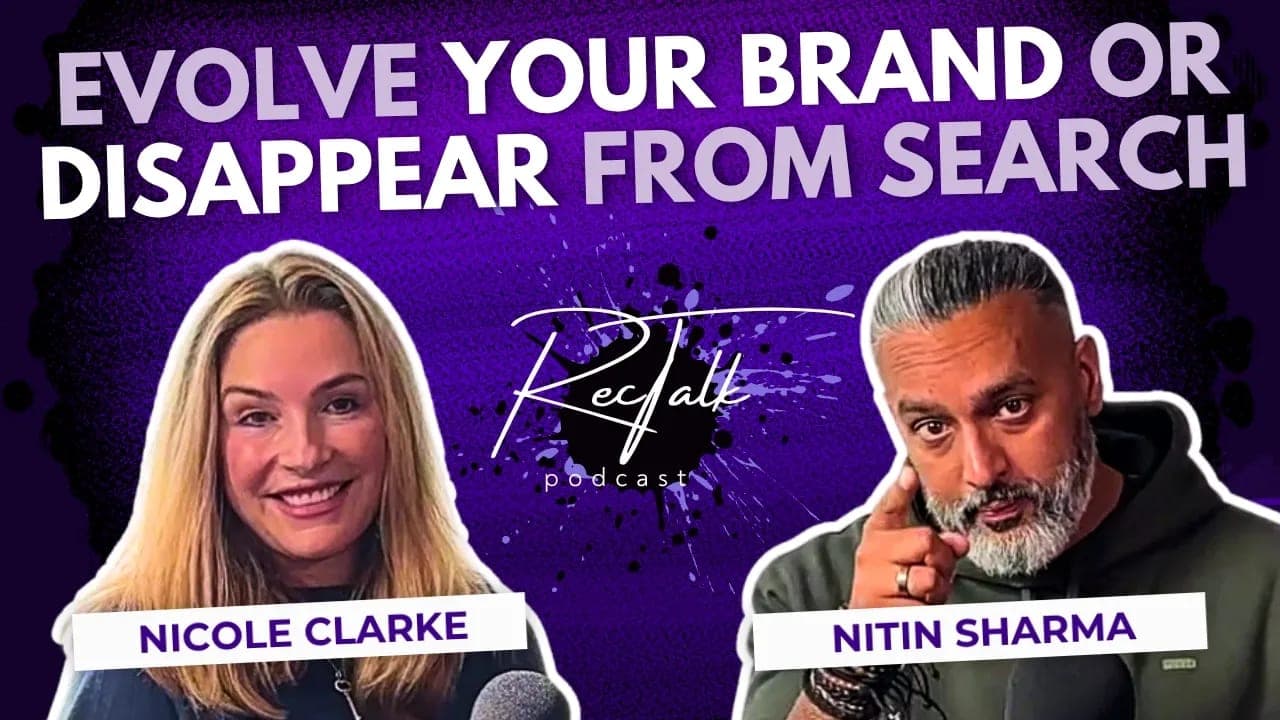
ChatGPT reached 900 million weekly active users in early 2026. Gemini surpassed 750 million monthly active users by the end of 2025. These aren't just messaging apps — they're where a growing share of professional and business queries are being asked and answered. When a hiring manager wants to find a specialist recruitment agency in their sector, they're increasingly typing that question into an AI assistant rather than a search engine. Nicole Clarke, Co-Founder of Shazamme (opens in a new tab), joined Nitin Sharma on RecTalk to explain what that shift means for recruitment agencies — and why most agency websites are not built for the world that's already here.
The Shift That's Already Happening
Traditional SEO is built around a specific model: a user types keywords into Google, Google returns a list of ranked links, the user clicks one. Everything about recruitment website design for the last decade has been optimised for that journey — rankings, meta titles, backlinks, page speed, structured data that helps Google index content.
That model is breaking down. AI Overviews now appear in roughly 25.8% of Google searches, reducing clicks to websites by as much as 38% in some categories (SEO Sherpa (opens in a new tab)). And when someone uses ChatGPT, Gemini, Perplexity, or Claude to ask a question directly — "which recruitment agencies specialise in renewable energy engineering in the Midlands?" — there's no list of links. There's an answer. The AI names a source, or it doesn't. If it doesn't name your agency, you don't exist in that search.
This is the shift Nicole is describing. The question is no longer just "does your website rank in Google?" It's "does your agency get cited when AI models answer questions in your niche?" Those are related but different problems — and solving the second one requires a different approach.
Why a Beautiful Website Is No Longer Enough
The recruitment industry has spent a lot of money on attractive websites. Clean design, strong imagery, compelling headlines about "finding your next great hire." That investment hasn't been wasted — a professional website still matters for first impressions and client conversion. But in an AI-first search environment, the aesthetics of a website are almost irrelevant to whether an AI model cites it.
What AI models extract and rely on is different from what good web design delivers. They're looking for clear, structured, specific information about what an agency does, where it operates, which sectors it serves, and what evidence exists that it's credible and trusted. A beautifully designed homepage with a vague tagline and no structured content about sector specialisms, client outcomes, or geographic focus is essentially invisible to an AI looking for sources to cite.
Nicole's point is direct: agencies that have invested in brand without investing in content — specific, structured, evidence-based content — are at a growing disadvantage as AI search captures more of the query volume that would previously have come to them through Google.
What AI Models Actually Look For
The emerging discipline of Answer Engine Optimisation (AEO) — sometimes called LLM Optimisation or Generative Engine Optimisation — is built around understanding what signals AI systems use when deciding which sources to cite. Several patterns are consistent across the research:
Trust signals carry more weight than keywords. Google Reviews, third-party testimonials, case studies, and published content on specialist industry platforms are more likely to be cited by AI models than well-optimised internal pages. 84% of AI citations come from earned media — third-party publications — rather than brand-owned pages (SEO Sherpa (opens in a new tab)). If no one outside your own website is talking about you, AI models have limited reason to cite you.
Structured content answers questions directly. Pages that open with a clear answer to a specific question — FAQ format, structured landing pages, location and sector-specific content — are cited more reliably than traditional blog-style introductions. If a client might ask "what recruitment agencies specialise in fintech in London?", your website needs a page that answers that question with precision, not a generic "About Us" statement.
FAQ pages and location pages are not optional extras. They're the primary mechanism through which AI models extract specific, answerable content from your site. Agencies that treat these as low-priority template pages are missing a significant visibility opportunity.
Entity signals matter. Marking up your agency correctly — as an EmploymentAgency entity rather than a generic Organisation — helps AI engines understand what kind of business you are, which shapes how and when you get cited in relevant queries.
The Traffic That Does Come From AI Converts Better
There's a counterintuitive finding in the early data on AI-referred traffic: it converts at a significantly higher rate than traditional search traffic. One case study from Seer Interactive found ChatGPT referral traffic converting at 15.9% compared to 1.76% for Google organic (HubSpot (opens in a new tab)). The reason makes sense in context: someone who asked an AI assistant for a specific recommendation and clicked through to a cited source is further down the decision-making process than someone who typed a keyword into Google and started browsing. The intent is higher, the trust is already partially established.
Lower volume, higher conversion. For a recruitment agency, a handful of well-qualified inbound enquiries from AI referrals may be worth considerably more than a large volume of generic Google traffic that never converts.
The Window Is Now
Nicole's assessment of the opportunity is specific: the next 12 to 18 months represent a window for recruitment agencies to establish AI visibility before the landscape consolidates. AI search is growing rapidly but the optimisation discipline is still early. Agencies that build their content structure, trust signals, and entity footprint now — before every competitor has done the same — will have a positioning advantage that's genuinely difficult to replicate quickly. Research suggests it takes 8 to 14 weeks from content publication to consistent citation appearance in AI search results, with reliable first-cite positioning requiring 10 or more weeks of consistent effort (All-EO (opens in a new tab)). Starting in a year means being 12 to 18 months behind the agencies that started now.
Real Talk
The agencies that get cited by AI aren't the ones with the best-looking websites. They're the ones with the clearest specialist positioning, the most structured and specific content, and the strongest evidence of credibility in third-party sources. That's not a technology problem — it's a content and reputation problem. And for specialist recruitment agencies with genuine sector expertise, it's an eminently solvable one.
This post is inspired by the RecTalk episode with Nicole Clarke of Shazamme: Why AI Search Will Replace SEO: The Future of Recruitment Websites (opens in a new tab). Watch the full conversation on YouTube. Find out more about Shazamme at shazamme.com (opens in a new tab).
Looking for recruitment website and marketing technology built for the AI era? Browse 1,000+ vetted recruitment suppliers and 49,000 real reviews — free — at rectools.io.