Only 10% of Recruitment Firms Run AI End to End: Vanessa Raath on Where the Money Really Is
By RecTalk Media
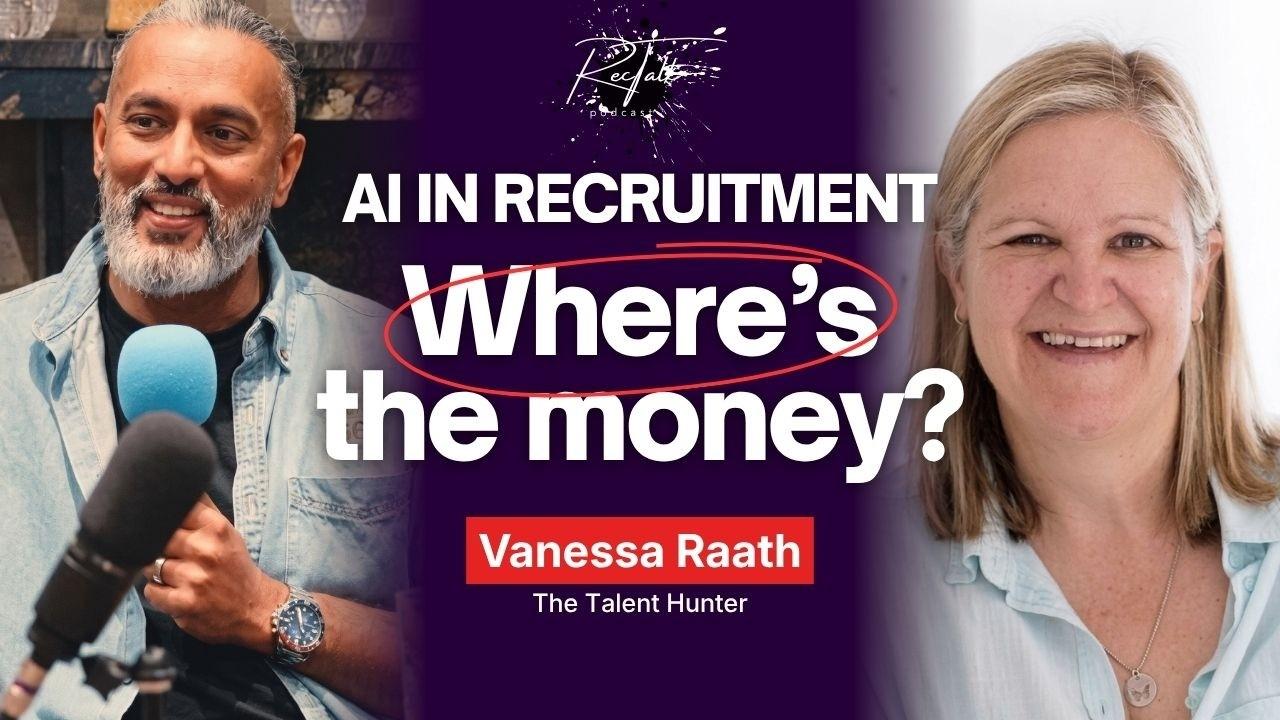
Folks, here's the awkward bit. Bullhorn's latest GRID research found that top-performing staffing firms are four times more likely to use AI (opens in a new tab), yet only 10% of firms have implemented agentic AI across their full workflow (opens in a new tab). A year earlier, firms in Bullhorn's 2025 survey predicted AI across the workflow could free up an extra 17 hours per week for each recruiter (opens in a new tab). So if everyone's saving time, where's the extra profit? On this episode of RecTalk (opens in a new tab), Nitin Sharma puts that question to Vanessa Raath, AI literacy and fluency trainer and founder of The Talent Hunter.
The money goes to firms that go all in
Asked for the strongest example of AI actually moving profit, Vanessa didn't point to the person firing off a sourcing prompt "once every second day". The winners are the ones who've fully committed, and her mantra sums up how they do it:
"Let's let AI do the admin and let's let humans focus on relationships."
AI lets them scale up their volume, she said, "but they are still keeping the human in the relationship."
Stop prompting, start chaining
For a UK client, Vanessa is building prompt chains that run by themselves. A job description becomes a candidate persona, the persona becomes a sourcing task, and that task runs on a schedule at 8am every morning. You sit down and there are ten new people waiting.
The same trick works for business development: let the model do the digging on funding rounds and hiring plans that recruiters used to do by hand. Her point is that this is agentic AI without the scary bit. You don't need to code. You just need to stop going "one prompt, one result" and walking away.
So what are we actually paying recruiters for?
This was Nitin's opening question, and Vanessa's answer was blunt: personal brand has gone from nice-to-have to must-have.
"When that person who doesn't know you from a bar of soap goes and looks at you online to assess your personal brand, that's where the recruiter is going to earn their weight."
The recruiters who won't be replaced have niched, know their market and use AI to free up time. Then they put that time back into coffee conversations, in-person events and relationships.
Nitin pushed back: is AI just helping weaker recruiters hide behind notetakers they never read? Vanessa agreed that a transcript alone won't improve a conversation. But she's seen a US firm's L&D team analyse a week of recruiter calls to spot who needs help with closing. She does it herself, too, dropping sales calls into Claude and asking: "Where could I have tried to close this sooner?"
Magpie syndrome is wrecking tech stacks
Vanessa's biggest frustration with recruitment tech buying? Magpie syndrome: "I went to a conference, they mentioned this name, everyone's using it. I must have it."
She also sees a split in CRMs. The AI-native ones built recently are "flying because they're so easy to use". Some legacy systems are hard to leave, aren't AI-native and aren't adding connectors fast enough. Before you sign up for 12 or 24 months, she suggests:
- Audit your tech stack
- Find your friction points and what's delaying time to hire
- Only then pick a tool, or ask whether you could build it yourself
Building is getting very real. Nitin was quoted around £15,000 for a podcast platform. Instead, he and a friend used Claude to build a Netflix-style web app in two and a half days, and it's now the Recruitment Podcast Network's MVP. Vanessa built a pre-training survey tool during two 45-minute conference talks, something she'd otherwise have paid a developer "over 10,000" for.
Your first build, in four steps
Nitin asked for the recruiter's equivalent of getting Doom to run on any device. Vanessa's starter plan:
- Pay for one LLM. Pick ChatGPT or Claude and commit.
- Find a repeatable task that you or your team are sick of doing.
- Talk, don't type. "Recruiters, we overcommunicate," so speak to it and explain your business.
- Build a skill. Her most common example: turning a raw CV and a recorded conversation into a candidate profile in your own format, ready to send to a client.
Once that's working, think bigger with a vibe-coded web app. Just don't skip the boring bit. If you're handling candidate data, ask up front whether it's GDPR compliant and secure, and plan for scale before you build.
Why mass outreach won't die
Nitin's LinkedIn inbox is "beyond sensible", and Vanessa doesn't see an end in sight. It's "become too easy to generate loads of content and shoot it out into the world and then sit back, tick a big box", and the industry rewards the wrong behaviours. Send a thousand messages and one reply might be enough for a placement.
Nitin's response: "A broken clock is right twice a day. Doesn't mean it's a good clock." Vanessa's view is that the backlash against AI slop is pushing people back to conferences, tangible gifts and real photos. Authentic is winning.
Real talk: it's an ultramarathon
Here's the reality check: Vanessa says at least 50% of the people who contact her don't pay for a large language model at all. Her advice if you're feeling the overwhelm? Unplug. She took three weeks off and came back keener than before. Treat AI fluency like training for an ultramarathon, not a sprint.
Want the full conversation? Watch or listen to Vanessa Raath on RecTalk (opens in a new tab).