AI Is Useless Without Your Data: 5 Fixes to Make Before You Buy Another Recruitment Tool
By RecTalk Media
Everyone wants to be "at the cutting edge" with AI. The trouble is, most businesses aren't ready for it. A Gartner survey of data management leaders (opens in a new tab) found that 63% of organisations either don't have the right data management practices for AI or aren't sure whether they do. In the same release, Gartner predicts that through 2026, organisations will abandon 60% of AI projects that aren't supported by AI-ready data. And closer to the desk, Validity's State of CRM Data Management 2025, as compiled by Webtonic (opens in a new tab), found that 76% of respondents say less than half of their CRM data is accurate and complete.
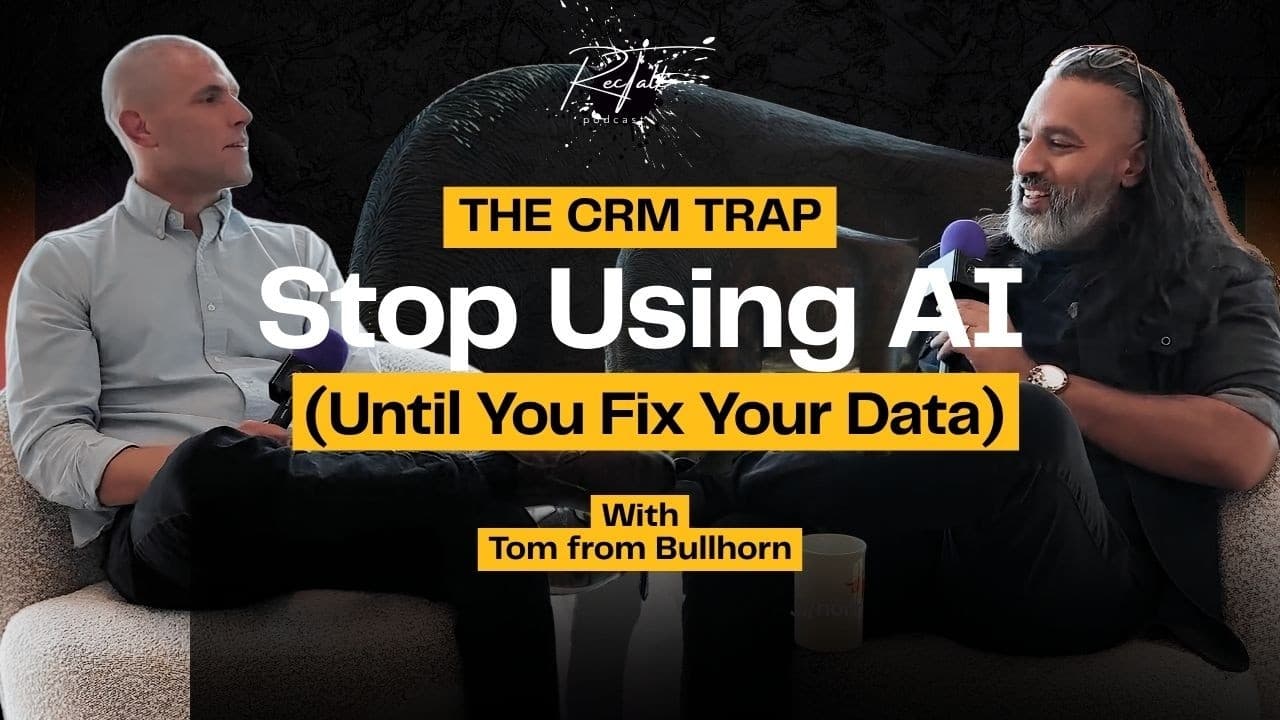
So when Nitin Sharma went to Bullhorn HQ in London for this episode of RecTalk, Tom, Engagement Manager of Customer Success at Bullhorn, had a simple message: sort your data before you chase the shiny stuff. Tom's been at Bullhorn for over seven years, and before that he was a recruiter himself, starting out in construction temp in 2013. (He doesn't miss Friday morning timesheets.) Watch or listen to the full episode on RecTalk (opens in a new tab).
Why AI tools flop on messy recruitment data
Tom hears the same thing from recruitment leaders all the time: we need to be using AI. His answer is blunt:
"No, we need to look at the data first. If we've not got good data, the AI tools that we use day in, day out aren't going to be any good to us."
Nitin was honest about why this keeps happening. Business owners care about the bottom line, and he reckons plenty of people would openly take "a 300k a year biller who doesn't log a single note on the CRM over a 120k a year biller who logs everything meticulously."
Fair enough on a Friday afternoon. But as Nitin put it, this is "the difference between planning for tomorrow versus dealing with today." The candidate who isn't ready now could be your Monday starter in three months, but only if somebody wrote down why.
Fix 1: Choose consistency over volume
What counts as "good data"? Tom admits it's different for every business, but his advice to clients is clear:
"Consistency of data is better than just having a whole load of data that we don't understand."
The test: pull any candidate record out of 50. Does it have the same core details as the others? Think:
- Salary requirements
- Notice period
- Location
- Travel
Fix 2: Keep it simple, strip it back
Bullhorn lets you customise and capture loads of data points. But Tom says the most successful customers he sees do the opposite of cramming everything in: "Keep it simple, strip it back."
His reasoning is pure real talk about humans. The more you pile onto consultants' plates, "the more they're going to try and cut corners," and then the data becomes inconsistent. "So, what's the point of having it?"
The episode included a story that shows exactly this. A business changed the first option on a candidate-source dropdown to "I don't care" to see who was just tabbing through. Around 80% of records logged that week reportedly went down as "I don't care". Good luck working out which job board gives you a return after that.
Fix 3: Use AI note-takers, but keep your eyeballs on them
Nitin asked whether AI note-takers are making recruiters lazy. Tom uses one himself and gave a balanced answer. On the plus side, he reckons "my listening has got better because I have more time to concentrate on what people are saying." On the other hand, the notes aren't in his own words or nuance. They're "really good, I think, for landmarking".
Tom explained that Bullhorn's Amplify features transcribe the call, write a note and then suggest field updates, like changing the current salary field. Crucially, they ask your permission first instead of updating fields on their own. That matters. Tom's example: mention the University of London a few times, and a system might decide you live in London, even if you left years ago.
If you're shopping around, panel members such as CoRecruit also push structured call notes into your ATS or CRM.
Fix 4: Rinse the sponge before buying something new
From where Tom sits in customer success, he says there's been an uptick over roughly the last nine months in clients asking one question: "Am I rinsing the sponge?" In other words, am I getting everything out of the system I already pay for, before I add AI on top?
The other big one is adoption. With a new tool getting hyped every week, leaders want their consultants working from a single source of truth. As Tom put it, "These tools that we're using are only as good as the data that we've got behind them."
Fix 5: Capture what you can't buy
Nitin pushed back: you can buy data now, or script it from LinkedIn. Tom's reply? "Don't forget that your data is a financial asset to your business as well."
Nitin then made the point himself. Names, job titles and email formats are the tip of the iceberg. The real value sits in why someone wants to leave, which role would make them take your call, and whether they could become a client.
Tom thinks that relationship data matters more as AI spreads, because people will crave real conversations:
"There's things AI at the moment can't handle. It can't handle a counter offer, a rejection... I am the difference. I'm the recruiter."
The bottom line
Before you sign up for another subscription, check whether your consultants are logging the same basics, whether your CRM is the single source of truth, and whether you're using the features you've already got. Or, in Tom's closing words: "AI is useless without your data."
Want to see how Bullhorn fits your workflow? Have a look at its rectools® page, and catch the full conversation with Tom and Nitin on RecTalk (opens in a new tab).